Slides: OCD: Not just even numbers and organisation
There are 16 slides. Each one has a picture of the slide, followed by its text and a description of what it shows.
Slides for “OCD: Not just even numbers and organisation” (PDF, 307KB). The PDF isn’t fully accessible, but this page has everything it does.
Slide 1
The title slide. It reads “Obsessive-Compulsive Disorder (OCD)”, with the subtitle “Not just even numbers and organisation”. A teal ribbon, which is the symbol of OCD, is in the top right corner. The background is light green, like all the slides in this talk.
Slide 2
A section slide with just the heading “What is OCD?” in the middle.
Slide 3
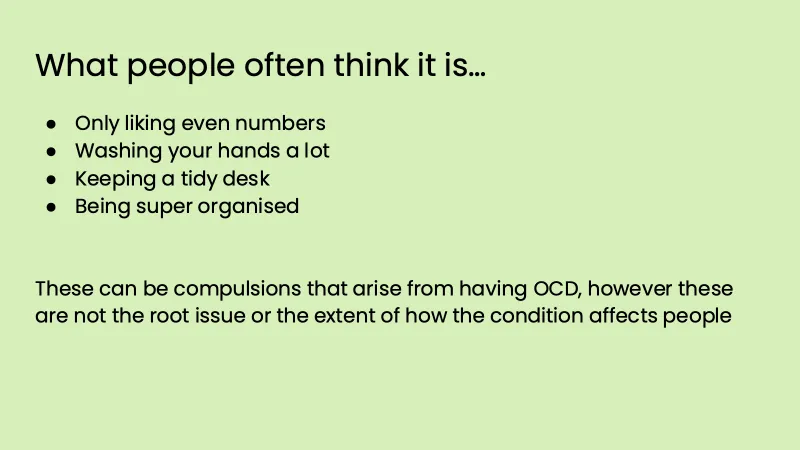
The heading is “What people often think it is…”, with a list:
- “Only liking even numbers”
- “Washing your hands a lot”
- “Keeping a tidy desk”
- “Being super organised”
Below the list: “These can be compulsions that arise from having OCD, however these are not the root issue or the extent of how the condition affects people”.
Slide 4
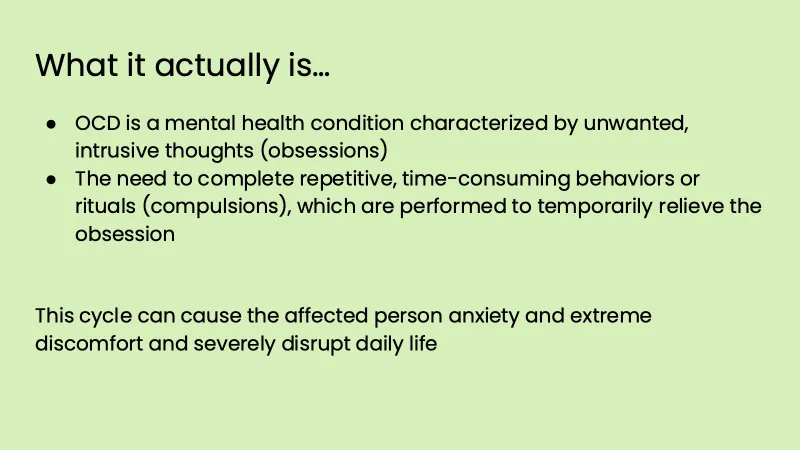
The heading is “What it actually is…”, with two points:
- “OCD is a mental health condition characterized by unwanted, intrusive thoughts (obsessions)”
- “The need to complete repetitive, time-consuming behaviors or rituals (compulsions), which are performed to temporarily relieve the obsession”
Below the list: “This cycle can cause the affected person anxiety and extreme discomfort and severely disrupt daily life”.
Slide 5
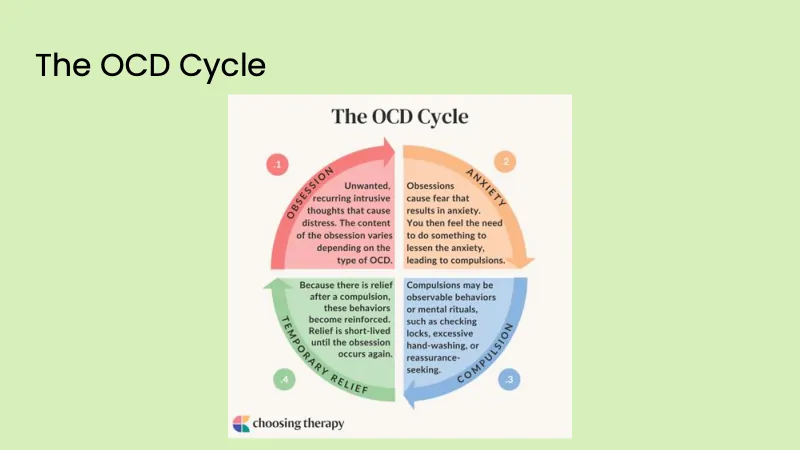
The heading is “The OCD Cycle”. Under it is a diagram from Choosing Therapy, with its own title “The OCD Cycle” and the Choosing Therapy logo in the bottom left corner. The diagram is a circle split into four coloured quarters, numbered 1 to 4. Curved arrows around the edge go clockwise from one quarter to the next, and from the last quarter back to the first, so the cycle starts again.
- “Obsession” (red, top left): “Unwanted, recurring intrusive thoughts that cause distress. The content of the obsession varies depending on the type of OCD.”
- “Anxiety” (orange, top right): “Obsessions cause fear that results in anxiety. You then feel the need to do something to lessen the anxiety, leading to compulsions.”
- “Compulsion” (blue, bottom right): “Compulsions may be observable behaviors or mental rituals, such as checking locks, excessive hand-washing, or reassurance-seeking.”
- “Temporary relief” (green, bottom left): “Because there is relief after a compulsion, these behaviors become reinforced. Relief is short-lived until the obsession occurs again.”
Slide 6
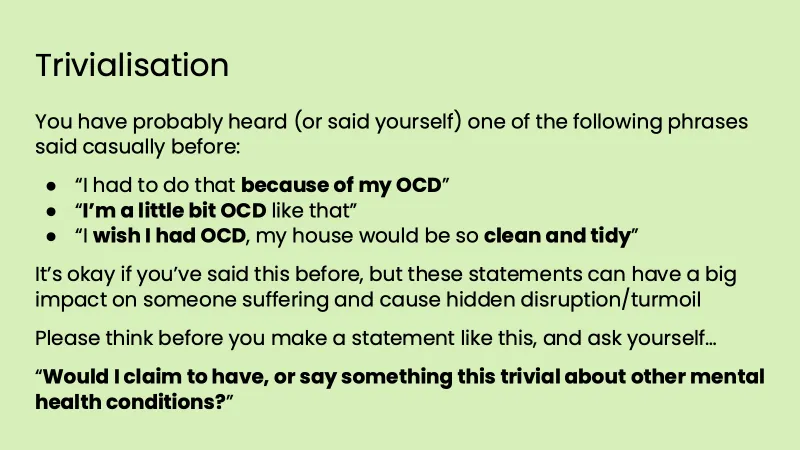
The heading is “Trivialisation”. It reads: “You have probably heard (or said yourself) one of the following phrases said casually before:”
- “I had to do that because of my OCD”
- “I’m a little bit OCD like that”
- “I wish I had OCD, my house would be so clean and tidy”
Below the list: “It’s okay if you’ve said this before, but these statements can have a big impact on someone suffering and cause hidden disruption/turmoil”.
Then: “Please think before you make a statement like this, and ask yourself…”
The slide ends with a question, all in bold: “Would I claim to have, or say something this trivial about other mental health conditions?”
Slide 7
The heading is “Example video”. Under it is a content warning, in smaller text:
“WARNING: The linked video is intense and dramatic from start to finish, and depicts someone in OCD crisis. It may be triggering, or difficult to watch.
If you decide to watch it, please ensure that you allow yourself time after to decompress. Remember that you can pause, or stop watching, at any time.
If you need to talk about it afterwards, we are here to support you, so please don’t hesitate to send a private message”
Slide 8
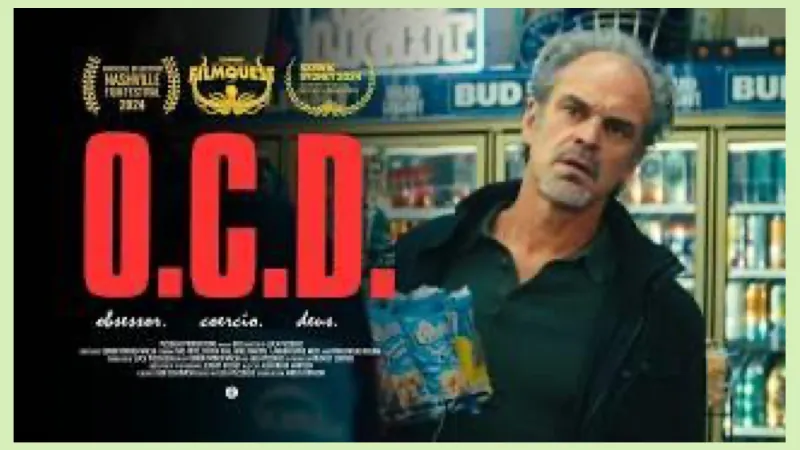
This slide is the video itself: the thumbnail of the short film “O.C.D.”, on YouTube (external site). The content warning on slide 7 is about this film.
The thumbnail is the film’s poster. On the left, on a black background, the title “O.C.D.” is in large red capital letters. Above it are three gold award laurels. Under the title is a line of white handwritten words, and some small credit text.
On the right, a man with grey hair and a grey beard, in a dark jacket, holds a blue packet of snacks in a shop. He looks to one side, worried. Behind him are drinks fridges and “Bud” signs.
Slide 9
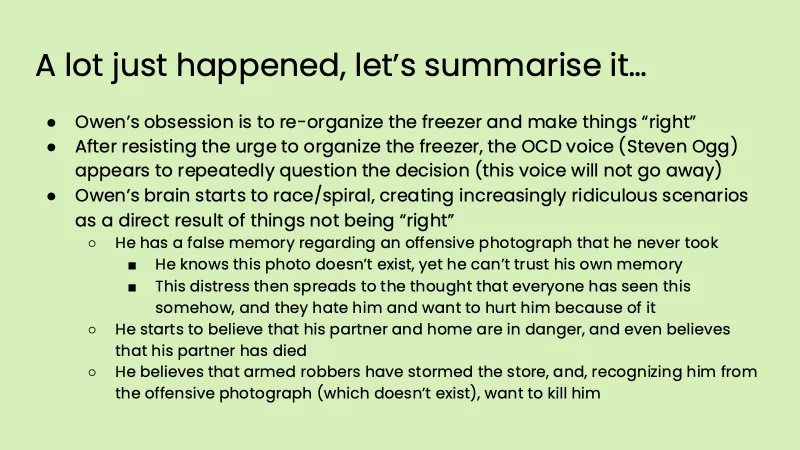
The heading is “A lot just happened, let’s summarise it…”, with a list:
- “Owen’s obsession is to re-organize the freezer and make things ‘right’”
- “After resisting the urge to organize the freezer, the OCD voice (Steven Ogg) appears to repeatedly question the decision (this voice will not go away)”
- “Owen’s brain starts to race/spiral, creating increasingly ridiculous scenarios as a direct result
of things not being ‘right’”
- “He has a false memory regarding an offensive photograph that he never took”
- “He knows this photo doesn’t exist, yet he can’t trust his own memory”
- “This distress then spreads to the thought that everyone has seen this somehow, and they hate him and want to hurt him because of it”
- “He starts to believe that his partner and home are in danger, and even believes that his partner has died”
- “He believes that armed robbers have stormed the store, and, recognizing him from the offensive photograph (which doesn’t exist), want to kill him”
- “He has a false memory regarding an offensive photograph that he never took”
Slide 10

A section slide with just the heading “Getting help” in the middle.
Slide 11
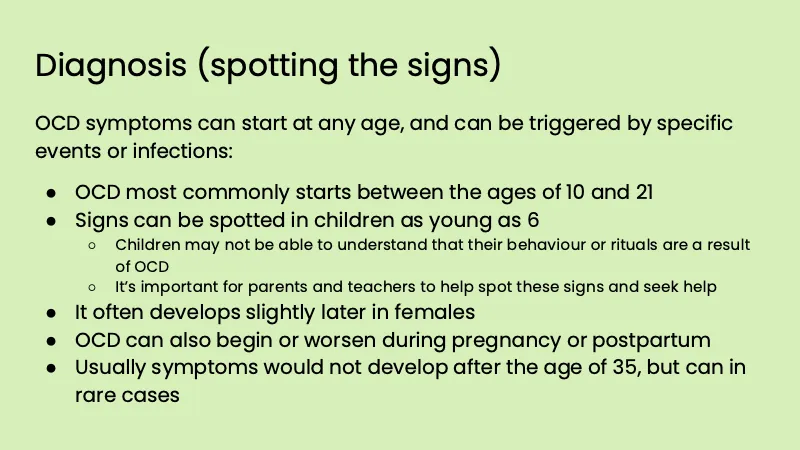
The heading is “Diagnosis (spotting the signs)”. It reads: “OCD symptoms can start at any age, and can be triggered by specific events or infections:”
- “OCD most commonly starts between the ages of 10 and 21”
- “Signs can be spotted in children as young as 6”
- “Children may not be able to understand that their behaviour or rituals are a result of OCD”
- “It’s important for parents and teachers to help spot these signs and seek help”
- “It often develops slightly later in females”
- “OCD can also begin or worsen during pregnancy or postpartum”
- “Usually symptoms would not develop after the age of 35, but can in rare cases”
Slide 12
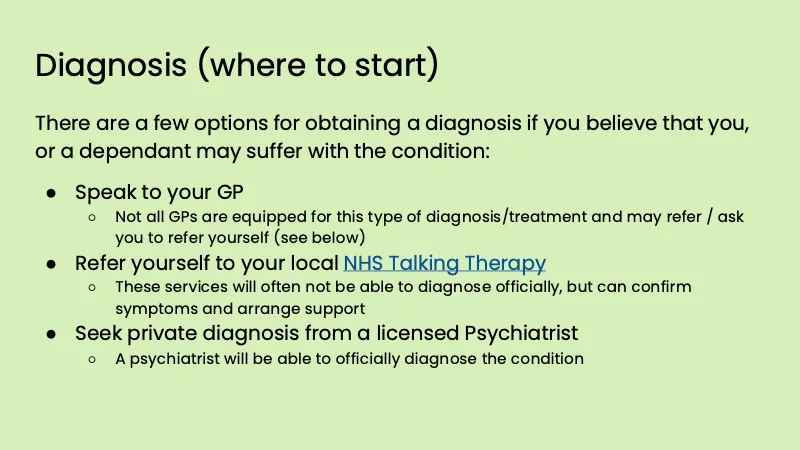
This slide is about where to start: a general practitioner (GP), the National Health Service (NHS), or a private psychiatrist. The heading is “Diagnosis (where to start)”. It reads: “There are a few options for obtaining a diagnosis if you believe that you, or a dependant may suffer with the condition:”
- “Speak to your GP”
- “Not all GPs are equipped for this type of diagnosis/treatment and may refer / ask you to refer yourself (see below)”
- “Refer yourself to your local
NHS Talking Therapy (external site)”
- “These services will often not be able to diagnose officially, but can confirm symptoms and arrange support”
- “Seek private diagnosis from a licensed Psychiatrist”
- “A psychiatrist will be able to officially diagnose the condition”
“NHS Talking Therapy” is a link on the slide.
Slide 13
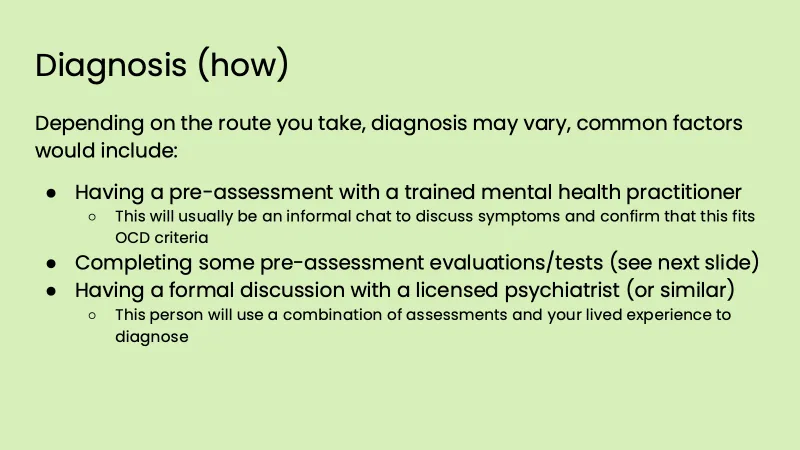
The heading is “Diagnosis (how)”. It reads: “Depending on the route you take, diagnosis may vary, common factors would include:”
- “Having a pre-assessment with a trained mental health practitioner”
- “This will usually be an informal chat to discuss symptoms and confirm that this fits OCD criteria”
- “Completing some pre-assessment evaluations/tests (see next slide)”
- “Having a formal discussion with a licensed psychiatrist (or similar)”
- “This person will use a combination of assessments and your lived experience to diagnose”
Slide 14
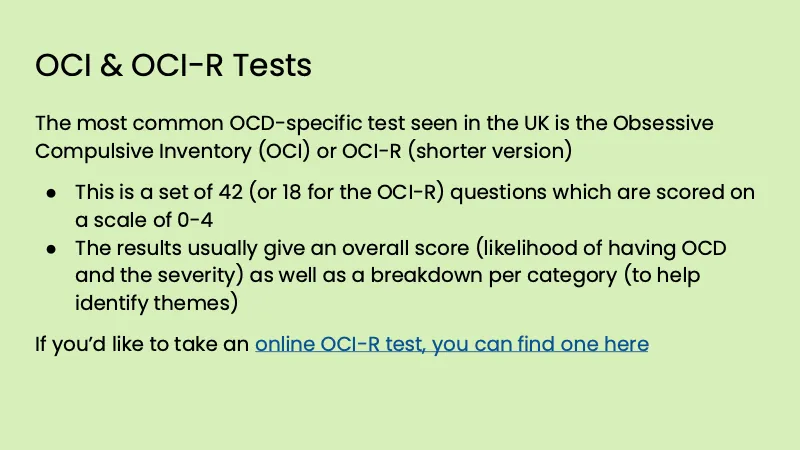
This slide is about the Obsessive Compulsive Inventory (OCI) and its shorter, revised version, the Obsessive Compulsive Inventory, Revised (OCI-R). The heading is “OCI & OCI-R Tests”. It reads: “The most common OCD-specific test seen in the UK is the Obsessive Compulsive Inventory (OCI) or OCI-R (shorter version)”.
- “This is a set of 42 (or 18 for the OCI-R) questions which are scored on a scale of 0-4”
- “The results usually give an overall score (likelihood of having OCD and the severity) as well as a breakdown per category (to help identify themes)”
Below the list: “If you’d like to take an online OCI-R test, you can find one here (external site)”. The words from “online” to the end are a link on the slide.
Slide 15
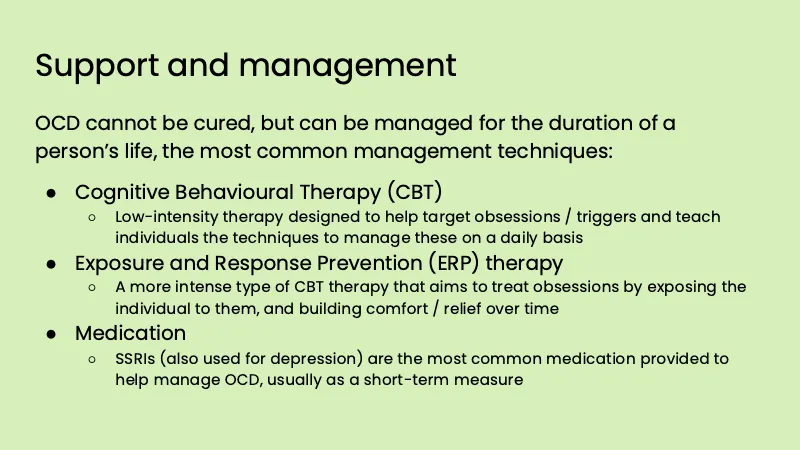
The heading is “Support and management”. SSRIs are selective serotonin reuptake inhibitors, a type of antidepressant. The slide reads: “OCD cannot be cured, but can be managed for the duration of a person’s life, the most common management techniques:”
- “Cognitive Behavioural Therapy (CBT)”
- “Low-intensity therapy designed to help target obsessions / triggers and teach individuals the techniques to manage these on a daily basis”
- “Exposure and Response Prevention (ERP) therapy”
- “A more intense type of CBT therapy that aims to treat obsessions by exposing the individual to them, and building comfort / relief over time”
- “Medication”
- “SSRIs (also used for depression) are the most common medication provided to help manage OCD, usually as a short-term measure”
Slide 16
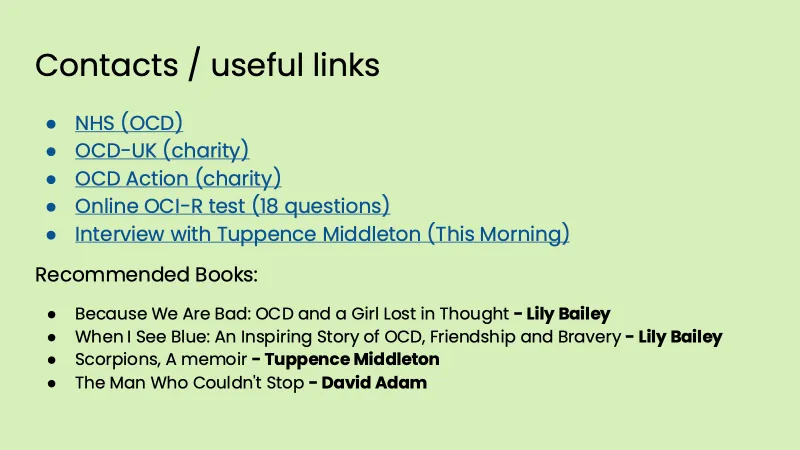
The heading is “Contacts / useful links”, with a list of links:
- NHS (OCD) (external site)
- OCD-UK (charity) (external site)
- OCD Action (charity) (external site)
- Online OCI-R test (18 questions) (external site)
- Interview with Tuppence Middleton (This Morning) (external site)
Then “Recommended Books:”, with each book’s title followed by its author’s name in bold:
- “Because We Are Bad: OCD and a Girl Lost in Thought”, by Lily Bailey
- “When I See Blue: An Inspiring Story of OCD, Friendship and Bravery”, by Lily Bailey
- “Scorpions, A memoir”, by Tuppence Middleton
- “The Man Who Couldn’t Stop”, by David Adam